The Platform, the Dam and the Drowned Village: Six Car-Free Reservoir Walks
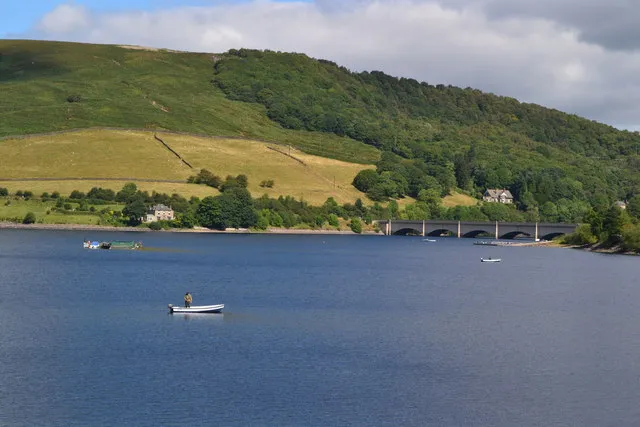
Photo: David Martin , CC BY-SA 2.0, via Wikimedia Commons
Reservoirs are strange places to walk. They look natural until you notice the straight edge of a dam, the valve tower standing offshore, or a line of old wall running into the water. These are working landscapes with a quiet history underneath. The best ones also happen to sit within reach of a railway station, which makes them ideal for the short-light months of 2026: a train out, a loop on foot, a pub or café if you time it well, and a train home before the light goes.
Ladybower and the Derwent dams, from Bamford
The Hope Valley line drops you at Bamford, and from there it is a steady walk of around two and a half miles to the Fairholmes visitor hub at Ladybower. The classic circuit around Ladybower itself is roughly five miles, mostly on track and lakeside path. In wet weather the path near the water can turn claggy, so boots are better than trainers. The reward is the Derwent dam wall, where the spillway is at its most dramatic after rain.
The history is the draw as much as the walking. The Derwent and Ashopton valleys were flooded in the 1940s to supply the growing cities of the East Midlands. Ruins of Derwent village sometimes show themselves when levels fall. Fairholmes has a café and cycle hire, though opening hours thin out in winter. Return trains from Bamford are frequent enough for a half-day, but check the last one before you linger at the dam.
Rutland Water, from Oakham
Oakham station is the gateway to England's largest reservoir by surface area, and you do not need to tackle the full twenty-five-mile lap. From Oakham it is a walk of around a mile and a half to the western shore near Egleton, where the Hambleton peninsula gives a fine five- or six-mile loop. The surface is mostly good gravel track, with some road sections on the peninsula. This is a good choice when the ground elsewhere is sodden.
Rutland Water was created in the 1970s by flooding the Gwash valley. Upper Hambleton survived on its peninsula, while Nether Hambleton went under. The visitor centre at Whitwell has a café and toilets, and the views across to the church spire at Normanton are the postcard shot. Oakham has trains from Leicester, Peterborough and Cambridge, making it a genuinely useful car-free day out. Allow more time than you think for the walk back into town.
Meldon Reservoir, from Okehampton
Okehampton station, back on the national rail map via the Dartmoor line, is the start for a properly moorland-feeling reservoir walk. Follow the Granite Way for around two and a half miles to Meldon, then pick up the rough path around the reservoir. The circuit is about three miles, but the surface is uneven and can be very wet underfoot. This is not a pushchair route.
Meldon Reservoir was built in the 1970s, drowning a quiet valley beneath the western edge of Dartmoor. The dam is a blunt concrete statement, but the water beyond it is all moorland folds and rocky outcrops. The old Meldon Viaduct is nearby and worth a look. Okehampton has pubs and cafés for a late lunch, and the station itself has a decent waiting room. Winter trains are less frequent than in summer, so plan the loop around the timetable rather than the other way round.
Longdendale and Torside, from Hadfield
Hadfield station sits at the eastern end of Greater Manchester's rail network, and the Longdendale valley begins almost at the platform. Walk east for around a mile and a half to Torside Reservoir, where a circuit of roughly three miles uses the Longdendale Trail and lakeside paths. The trail is compact gravel and easy going; the water's edge can be muddy. If you want more, you can extend towards Woodhead, but keep an eye on the clock.
The chain of reservoirs here was built in the nineteenth century to quench Manchester's thirst, flooding a valley that once held farms and small settlements. The Woodhead tunnels and old railway alignments add to the sense of a landscape with layers. There is no café at Torside itself, so bring a flask and a sandwich. Hadfield has a few shops near the station, and return trains run regularly, though the last service can be early on Sundays.
Pontsticill Reservoir, from Pant
This one is a heritage-railway day out rather than a mainline jaunt. The Brecon Mountain Railway runs from Pant, near Merthyr Tydfil, to Pontsticill station beside the reservoir. From the station, a circuit of the water is around four miles on forestry tracks and open ground. It can be boggy after rain, and the route is not always waymarked clearly, so a map or phone app is useful.
The Taf Fechan valley was dammed in the 1920s to supply Merthyr and the surrounding towns. Pontsticill village sits above the water, and the reservoir's bell-mouth spillway is a striking piece of engineering. The heritage railway runs a limited winter service, so check dates before you travel. Pant is reachable by bus from Merthyr Tydfil, and the railway itself is the return journey. It is a slower day, but that is rather the point.
Rudyard Lake, from Rudyard
Rudyard Lake in Staffordshire is a reservoir with a holiday mood. The Rudyard Lake Steam Railway runs along part of the shore, and a circular walk of around three miles starts near the station. The path is a mix of lakeside track, boardwalk and muddy sections. It is not a mountain day, but it is a fine leg-stretcher with a café at Rudyard and another at the far end in season.
The lake was created in the 1790s to feed the Trent and Mersey Canal, making it one of the oldest reservoirs on this list. Rudyard Kipling's parents met here, which explains the name. The steam railway runs on selected days, so check its timetable before relying on it. For a car-free day, take the train to Stoke-on-Trent or Macclesfield and continue by bus, or use the local bus links from Leek. It is a good reminder that a reservoir day does not have to be remote to feel like a change of pace.
Practical notes for short days
These walks are all best done with a head torch and a waterproof in the bag from November onwards. Reservoir paths can be icy on the dam walls and boggy on the quiet side, so grip matters. Cafés and pubs often close earlier than in summer, and heritage railways run reduced timetables. Check return trains before you set off, and give yourself a buffer. The point is not to race the light, but to let the timetable shape a slower day out.