The Slow Train Pint: Six Branch-Line Halts Worth Building a Day Around
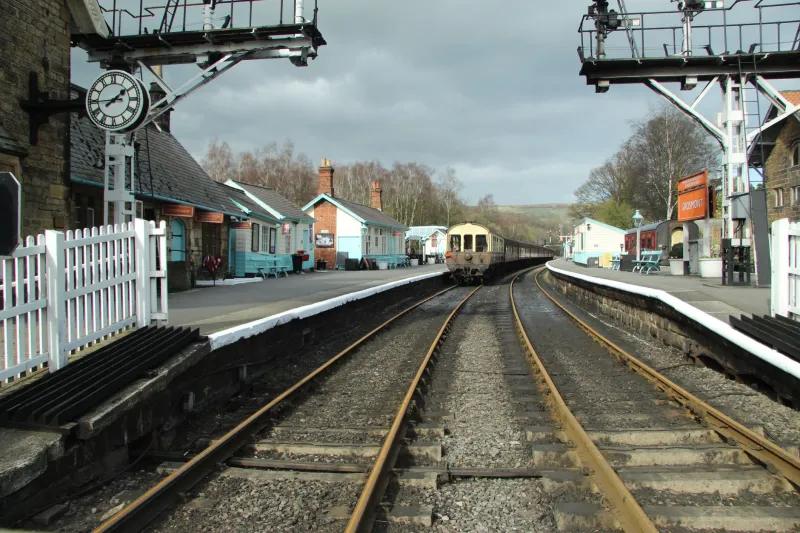
Branch lines have a rhythm of their own. The trains are short, the platforms are longer than they need to be, and the timetable leaves you two or three hours to fill between one departure and the next. That enforced pause is the whole point: you arrive somewhere small, you walk a loop, you find a pub, and you catch the next train home. No car, no parking app, no designated driver.
Six stations follow, all on lines with a genuine year-round service rather than a heritage timetable. Frequencies are modest and Sunday trains can be very thin indeed, so check times before you travel. Several of these are request stops — you need to tell the conductor, or put a hand out as the train approaches.
1. Lealholm, Esk Valley line
England's rural railways don't come much more rural than this. The Esk Valley line threads from Middlesbrough across the moors to Whitby, and Lealholm is its most understated stop: a stone platform above a village of cottages, a ford, stepping stones across the Esk, and a packhorse bridge that has been photographed far more often than its builders could have imagined. Walk down through the village and back along the riverbank; the loop barely takes an hour unless you sit on the bridge, which you will.
Walk: about 2.5 miles round trip to the stepping stones — flat, and muddy in equal measure. Trains: a handful each way Monday to Saturday, barely anything on Sundays. Pint: the Board Inn, a few minutes from the platform; two rooms, a fire, and kitchen hours that can stop mid-afternoon without warning. Best for: a slow village day with boots on and nothing booked.
2. Ravenglass, Cumbrian Coast line
The coast line runs so close to the shore here that you can hear the waves from the carriage. Ravenglass station is a curiosity in its own right, since the narrow-gauge La'al Ratty to Eskdale leaves from the same platform, and mainline trains are roughly hourly on weekdays — which makes a car-free day unusually easy. From the station it is about three miles there and back along the estuary to the gates of Muncaster Castle, returning by the beach. Flat, atmospheric, and workable in almost any weather short of a gale.
Walk: 3 miles round trip; extend up Muncaster Fell if the cloud is high. Trains: roughly hourly Monday to Saturday, thinner on Sundays. Pint: the Ratty Arms occupies the old station building, which is convenient to the point of laziness; winter afternoons can see it shut between services, so ring ahead. Best for: a coast-and-castle day where the train does the driving.
3. Horton-in-Ribblesdale, Settle to Carlisle line
Settle to Carlisle is the grande dame of English rural railways, and Horton is where the walkers get off. The Pennine Way passes the door, the Ribble Way heads up the valley, and the limestone starts almost immediately. A 3.5-mile round trip to Hull Pot — a collapsed cavern the size of a cathedral nave, usually dry, occasionally thundering — is the classic short outing. The path is rough in places and boots are non-negotiable.
Walk: 3.5 miles round trip to Hull Pot. Trains: roughly eight a day each way, with a better-than-expected Sunday service in summer. Pint: the Golden Lion sits yards from the platform and does food and bunk beds; the Crown in the village is quieter and more local. Both fill up when the forecast is good. Best for: big skies, limestone and a proper walk before lunch.
4. Llandovery, Heart of Wales line
The Heart of Wales is one of the slowest and loveliest lines in Britain, a crawl from Shrewsbury to Swansea that seems designed for people who have decided to stop rushing. Llandovery is a request stop — tell the conductor — and the town is a proper little market centre with a castle mound, a river running through it and a square that still does a decent trade on market day. The walk is short and gentle: down to the castle, along the Bran, and back through the streets.
Walk: 2 miles, flat, with optional extensions along the river. Trains: four or five each way on weekdays, nothing meaningful on Sundays. Pint: the Castle Hotel and the King's Head are both a short stroll from the station; Sunday kitchens in towns this size often finish early, so don't leave lunch until three. Best for: slow-travel purists and anyone who likes a town that hasn't been styled within an inch of its life.
5. Lelant, St Ives Bay line
The St Ives Bay branch is only four miles long but it keeps the sea in view for most of the way. Skip St Ives itself, get off at Lelant — the village stop, not Lelant Saltings — and walk the coast path back to town instead. That's around 3.5 miles of dunes, shells and sudden sea views, and you can catch the train back to St Erth at the end of it. Trains run roughly hourly, so there is no panic about missing one.
Walk: 3.5 miles one way to St Ives along the South West Coast Path. Trains: roughly hourly on the branch, more in summer. Pint: the Badger Inn is two minutes from the platform and takes Sunday lunch seriously, which means it fills early. Best for: walking a leg of the coast path without the car park fandango.
6. Whaley Bridge, Buxton line
The Buxton line climbs out of Manchester Piccadilly and reaches the edge of the Peak within half an hour. Whaley Bridge is the practical stop: hourly trains, a town with a bakery and a couple of proper pubs, and a three-mile loop around Toddbrook Reservoir and up to the Peak Forest Canal basin. The reservoir wall was rebuilt after the dramatic events of 2019, and walking round it is a good reminder that picturesque and engineered are not opposites.
Walk: 3 miles around the reservoir and canal basin, with hill options if you want them. Trains: hourly from Manchester, seven days a week. Pint: the Goyt Inn is a short stroll from the canal basin; straightforward food, well-kept beer. Best for: a half-day escape from the city with no plan beyond lunch.
The practical bits
Request stops are common on these lines. If you want to get off, tell the conductor when you board; if you want to get on, put your hand out clearly as the train approaches. Sunday services on rural routes are often a shadow of the weekday timetable, and some winter services vanish altogether.
Buy before you board where you can — machines, apps or a ticket office if one still exists — because not all of these trains carry a guard selling tickets, and penalty fares apply. A Railcard pays for itself quickly on a day out, and off-peak returns are usually flexible enough to allow a later train home after a long lunch.
Finally, treat the pub as part of the timetable rather than an afterthought. Rural kitchens close between services, chefs take Mondays off, and a chalkboard reading 'food 12–2.30' has ended more walks than rain ever has. Ring ahead. Then catch the train.