Round the Ramparts Before the Kettle: Six Walled Towns That Fit a Half-Day
There's a particular sort of satisfaction in walking a circle. Not an out-and-back with the same view twice, but a proper loop that closes itself, ending roughly where it began. Britain has a decent scatter of towns where you can do exactly that on medieval stone, and rather a lot of them have a railway station within ten minutes of the first gate.
This isn't a history lesson. It's about pacing: how long each circuit actually takes at a sensible walking speed, where the crowds bunch up and where they mysteriously don't, and how to fit the whole thing between a mid-morning arrival and a teatime departure without ever looking at your watch in a panic.
York: the long one, and worth the early start
York's bar walls run about two and three-quarter miles, and the station is a ten-minute walk from the river, another five to Micklegate Bar. That figure sounds daunting until you remember it's flat, mostly on a paved walkway, and broken by gates every few hundred yards.
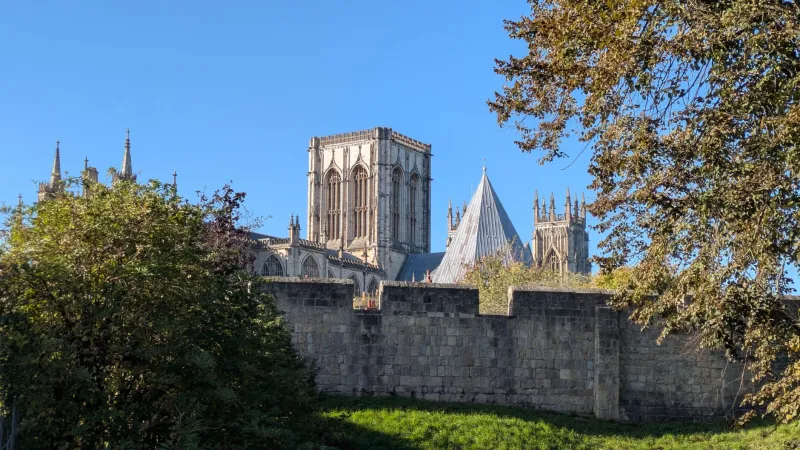
The trick here is direction. Most people pick up the walls at Bootham Bar, near the Minster, because that's where they happen to be standing. Start at Micklegate instead and you get the quietest stretch first — the run along the backs of gardens towards the railway, where the only company is a dog walker and the sound of trains you're not catching yet. Save the Minster-facing section for the afternoon, when the coach parties have thinned and the light hits the stone properly.
Exit points are generous: Monk Bar, Walmgate Bar, Fishergate Bar. If the weather turns, you're never more than four minutes from a street.
Chester: two miles, one long quiet side
The walk from Chester station down to the walls takes about fifteen minutes and is not the prettiest fifteen minutes in Cheshire. Persevere. The full circuit is around two miles, and the northern stretch past the canal and the railway bridge is where it goes properly still, with the racecourse visible but not audible.
The east side, above the River Dee, is the postcard and the busiest. Walk it in the evening, or accept the trade-off and enjoy the view anyway.
Conwy: the smallest circuit, done twice
Conwy is the cheat of the list. The station is practically against the wall, the full loop is barely three-quarters of a mile, and you can finish it in under twenty minutes without hurrying.
Which is why you should do it twice. Once in the morning, when the town is still yawning and the estuary is silver, and again late in the afternoon when the visitors have gone home and the towers go the colour of toast. Between the two, there's a castle, a small house with a large claim attached to it, and at least three places to get a decent sandwich.
Berwick-upon-Tweed: Elizabethan stone and a lot of sky
Berwick's walls are a different animal — later, lower, grassier, and far less trafficked than the medieval circuits. The station is five minutes from the ramparts and the loop is around a mile and a half, with the three bridges and the Tweed estuary doing most of the visual work.
Go in the late afternoon if you can. The light off the water is the whole point, and the benches along the northern rampart are rarely contested. The town itself rewards a wander afterwards, particularly the streets behind the Guildhall, which have a stubborn, slightly separate character that comes of changing hands between countries more than a dozen times.
Canterbury: the fragment circuit
Canterbury doesn't offer a complete ring, and pretending otherwise would be dishonest. What it does offer is a walkable sequence of fragments — Westgate Towers, a long stretch beside the ring road, the Dane John mound — stitched together into roughly a mile and a half of extremely pleasant strolling.
The trick is to walk it in reverse to the obvious direction. Everyone goes from Westgate towards the Dane John; go the other way and you'll have whole sections to yourself. The station is five minutes from the start, and the exit points drop you more or less inside the shopping streets, which is either a blessing or a hazard depending on your resistance to bookshops.
Southampton: the old town, in an hour
Southampton's walls are the surprise of the group. The station is a ten-minute walk from the Bargate, the surviving stretches are genuinely substantial, and the whole thing can be done in under an hour — which makes it the perfect option for a spare afternoon rather than a planned day.
The quiet bit is the western run past the medieval merchant's house and down towards the water, away from the shopping centre. God's House Tower, at the southern end, is a good place to stop and let the walk finish properly rather than just stop.
Working it round a timetable
A reasonable pace on stone or tarmac is two and a half to three miles an hour, allowing for the odd pause. That means York is a two-hour walk with stops, Chester about ninety minutes, and everything else comfortably inside an hour.
Build the day backwards from your train. Tea first, then the walk, or the other way round — but decide before you arrive, because the difference between a relaxed circuit and a rushed one is entirely in the ordering. Sunday services on these lines can be thin, and rural connections even thinner, so a flexible return ticket is worth the small premium.
And take the exit points seriously. A circuit that can be abandoned at four different gates is a circuit you'll actually enjoy, because you're never committed. That's the whole thing, really: half a day, one town, no car park, and the kettle already on somewhere near the platform.