Dial-a-Chapter: Six Red Phone Boxes That Reward a Short Walk
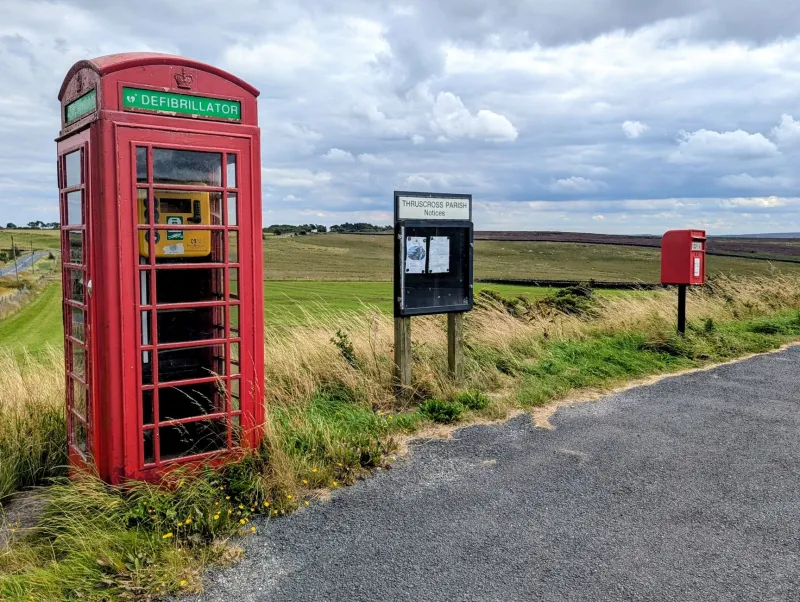
The red phone box has had a strange second life. Stripped of its original job, it has been adopted by villages that decided a small cast-iron hut was too useful to lose. Some are libraries. Some are larders. One or two are barely bigger than a cupboard and yet somehow contain a whole community's worth of goodwill. For a walker, they make excellent landmarks: a reason to choose one lane over another, a place to pause, and a reminder that hidden Britain is often not hidden at all. It is just small, local and easy to miss.
These six are worth building a day around. Check opening arrangements before you travel, especially outside summer, and treat what you find as a loan rather than a shopping opportunity.
Westbury-sub-Mendip, Somerset: the box that started a habit
Westbury-sub-Mendip's phone box library is the one people cite when they want to prove the idea works. It sits in the village, not on a dramatic clifftop, and that is the point. You walk a few quiet lanes, pass a church, find a box full of paperbacks, and suddenly the walk has a destination that is not a tea room or a car park.
By car, it is straightforward from the A371 between Cheddar and Wells. By rail, Castle Cary is the nearest useful station, but bus links are thin; a taxi for the last few miles is the realistic car-free option. From the village you can stretch the day with a lane walk towards the Mendip slopes. Take a book you have finished, leave it neatly, and do not rearrange the whole shelf as if you are curating it.
Kington Magna, Dorset: a library in the Blackmore Vale
Kington Magna is the sort of place where the phone box feels less like a novelty and more like a village hall annexe. The lanes around it are soft, hedged and made for a slow hour. This is not a day for big views. It is a day for noticing how many different greens a hedge can hold.
Gillingham in Dorset is the nearest station, with a short taxi or a long walk for the determined. Drivers can approach from the A30 or the lanes north of Shaftesbury. The box is a simple book exchange in spirit: borrow one, leave one, and keep the stock dry. If you are bringing a donation, a decent paperback beats a mouldering encyclopedia. The walk itself is the reward, with the box as a punctuation mark rather than the whole sentence.
Cwmdu, Powys: the box with a hill behind it
Cwmdu sits in that part of Powys where the Black Mountains start to feel close. The phone box here is a useful little civic outpost, and the surrounding lanes give you a walk with real shape. You can make a short loop of the village, or push on towards the lower slopes if the weather is behaving.
Abergavenny is the rail gateway, with bus connections along the A40 corridor; check times carefully, because this is not a turn-up-and-go kind of place. By car, Cwmdu is just off the A40 between Abergavenny and Crickhowell. The etiquette is the same as anywhere: take one book, leave one book, and do not use the box as a bin. A seed swap or a notice for a village event may appear alongside the paperbacks. That is not clutter. That is the system working.
Pett, East Sussex: a shelf by the marshes
Pett is a good example of how a phone box can become the whole point of a walk without pretending to be a tourist attraction. The village sits back from the coast, with Pett Level and the marshes nearby. The box gives you a reason to wander the lanes rather than simply drive to the sea and leave.
Three Oaks is the nearest station for the walker, though the final stretch is better suited to those who have checked the map and the daylight. By car, approach from the A259 between Hastings and Rye. This is birding country, marsh country, and a place where the light does a lot of the work. The box might hold books, local notices or a small stash of useful things. Borrow one, leave one, and leave the door as you found it. A phone box library in a damp coastal village only survives if people treat it like a shared shelf, not a charity shop with no staff.
Brilley, Herefordshire: the honesty larder with a door
Not every adopted box is for books. Some have become tiny honesty shops, with eggs, preserves or a few store-cupboard staples left on a shelf and a tin for the money. Brilley, in the Herefordshire hills, is the kind of place where that makes perfect sense: a scattered community, a lane junction, and a box that is more useful than a noticeboard.
Hereford is the nearest rail hub, but the final miles are bus-and-taxi territory at best. By car, the lanes west of the A4111 are the approach, and they are narrow enough to make you glad you are not in a hurry. If you buy something, pay properly. If you borrow a book, bring one back. If you have nothing to leave, leave the box tidier than you found it. That last rule applies everywhere.
Alstonefield, Staffordshire: the Peak District box
Alstonefield is a fine base for a short Peak District walk, and the phone box gives the village a small extra pull. This is not the dramatic Peak of postcards. It is a quieter version: stone walls, sloping fields, and lanes that reward a bit of aimless wandering.
Buxton is the nearest station, with bus connections into the White Peak; drivers can come in from Ashbourne or Leek. The box may hold books, local information or a small community stash. The point is not to tick it off. The point is to let it slow you down. Walk a loop, come back, swap a book, and then go home feeling that you have done something more useful than simply driven somewhere pretty.
The etiquette is the attraction
These boxes work because they run on a simple code. Borrow one, leave one. Do not cram. Do not donate damp or damaged books. Do not turn a village book exchange into a dumping ground for old DVDs and diet manuals. If there is an honesty tin, pay it. If there is a notice, read it. If the box is clearly someone's small labour of love, treat it that way.
That is also the wider argument. A phone box library is not a quaint relic. It is a small act of civic maintenance, the sort of thing that happens when people decide their place is worth a bit of effort. You will find grander days out in Britain, but you will not find many more honest ones. Dial-a-chapter, walk a lane, and see what is on the shelf.