No Roof, No Village, No Queue: Six Field Churches at the End of a Footpath
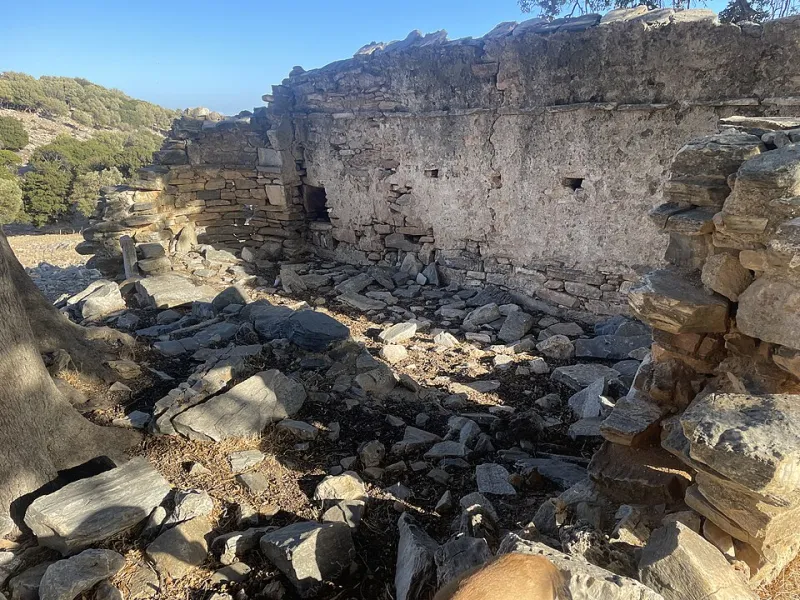
Photo: JBradyK, CC BY-SA 4.0, via Wikimedia Commons
There is a particular kind of quiet that only turns up in a field with a broken church in it. No till, no lanyards, no laminated panel telling you what to think. Just a flint wall, a font still standing in the open air, and the odd sense that a whole community once walked this way on Sundays and then, slowly and for a hundred small reasons, stopped.
These six are the real thing: churches that lost their villages. Some were emptied by the Black Death, some by enclosure, some by the sea, one by a landowner with a taste for parkland. All of them are reachable without a car, provided you're happy to finish the job on foot. Take a decent pair of boots and a flask. There's rarely anywhere to buy so much as a coffee at the other end.
Wharram Percy, North Yorkshire
The most famous of the lot, and still oddly under-visited, because the walk in is long enough to put people off. St Martin's sits in a fold of the Yorkshire Wolds above a dried-up fishpond, roofless since the sixteenth century, surrounded by the grassed-over ridges of a village that once held around thirty households. You can trace the tofts and crofts in low winter light without much imagination at all. The tower is a stub, the nave walls are waist-high in places, and the font is out there in the weather doing its best.
Getting there: train to Malton, then the bus up the Wolds to Wharram le Street, and about a mile of track and field path down to the church. Give yourself an hour in each direction and check the last bus back — this is not a route to improvise on a Sunday evening.
St Andrew's, Covehithe, Suffolk
Covehithe is the church that ate itself. The medieval nave was too big and too expensive for a shrinking parish, so in the seventeenth century the villagers built a small, neat church inside the ruins of the old one and let the rest fall down. You stand in a roofless shell with a complete little church sitting inside it like a keepsake in a box. Beyond the churchyard, the cliffs are going and the village is going with them; there are stumps of lost lanes in the sand.
Getting there: train to Halesworth or Lowestoft, bus towards Southwold, then a few miles of flat lane on foot. It's a lovely cycle too if you've brought one. The coast path between Southwold and Covehithe is the best approach.
St Mary's, East Somerton, Norfolk
A roofless nave, a flint tower, and a great oak growing straight up through the middle of the west end — this is the one that ends up on calendars. East Somerton's village dissolved into farmland centuries ago and the church was left to the weather. The tree did the rest. Go in late afternoon when the light comes sideways through the empty windows, and mind the roots, which have made a proper mess of the floor.
Getting there: train to Great Yarmouth, bus to Winterton-on-Sea, then a mile and a half of quiet lanes and a footpath. Combine it with a Winterton dune walk and you've got a full, gentle day.
St James's, Bawsey, Norfolk
On the fen edge west of King's Lynn, St James's stands alone above old quarry workings with nothing but hedge and water around it. It's a fragment — a shell of a nave and chancel, a bell-cote hanging on, a churchyard that has quietly gone over to nettles and ivy. It is not grand. It is, however, exactly the sort of place that rewards sitting down for ten minutes rather than photographing in ninety seconds.
Getting there: train to King's Lynn, then a bus out along the Gaywood road and a lane walk of about a mile. The paths get gloopy after rain; boots rather than trainers.
St Mary's, Eastwell, Kent
The village of Eastwell was cleared in the eighteenth century to improve the view from the big house, and the church was left stranded in parkland. What remains is a roofless, romantic ruin among trees, with a handful of monuments and tombs still legible inside the walls — including, so the story goes, the grave of a man who claimed to be a Plantagenet prince and lived out his days as a bricklayer. Whether you believe that or not, the setting does most of the work.
Getting there: train to Ashford International, then a local bus into the Wye and Boughton Aluph direction, finishing on foot through the park gates. The walk in is short but there's no pavement for the last stretch — keep dogs and children close.
St Mary's, Knowlton, Dorset
Here's the strange one. Knowlton's roofless church sits inside a circular earthwork that is older than the church by several thousand years — a Neolithic henge reused as a Christian site, with a Norman church plonked in the middle and abandoned in the seventeenth century. You stand in the ditch, look up at the ruined walls, and get a rather good lesson in how Britain recycles its holy ground.
Getting there: train to Poole or Bournemouth, bus to Wimborne Minster, then the Cranborne-bound service, which will leave you a mile and a half short. That last bit is a lane walk with hedges high enough to feel properly out of the world.
Visiting without being a nuisance
These places are not attractions. Several are on private land with a permissive path, some are in active churchyards, and a few are working farmland for the rest of the year. Keep to the marked route, shut gates, and don't climb the walls — flint and old mortar are not a climbing frame. If there's a donation box, use it. If there's a service on, wait, or come back later.
And do take the time to actually look: the font, the blocked doorway, the scratch dial by the porch, the initials cut into a gravestone by someone who couldn't afford a proper mason. That's the whole archive, and it's all out in the open, free, and mostly empty. Take a thermos. Stay a while.